A family of hand tools and desk implements for a Danish supplier to design schools, replacing a catalogue assembled from six different manufacturers.
Nordkant Industrial was asked to make the range recognisable across categories that share no technology: a staple gun, a stapler, a sharpener, an eraser, a squeegee, a sanding block, a set square. The studio’s decision was to unify by colour discipline and by grip, and to leave everything else to the demands of each object.
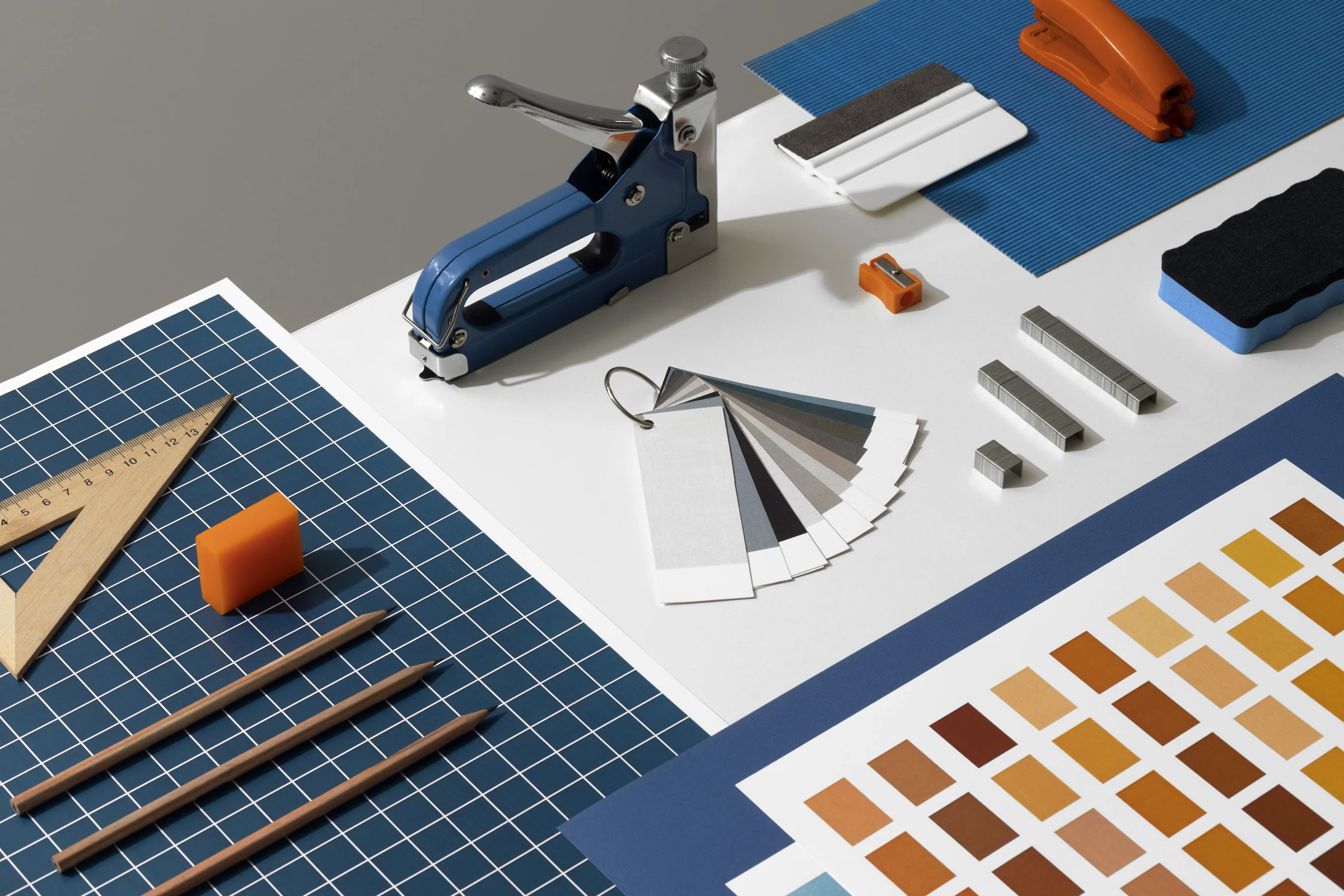
The colour system is two-part. Structural bodies are a saturated slate blue; anything the hand acts upon is orange. On the staple gun that means a blue body with an orange trigger interlock inside the handle; on the stapler the whole shell is orange because the whole object is the actuator. Applied consistently, the rule tells a student which part to touch before they have read anything.
Grip geometry is shared. Every hand-held item in the range uses the same 34 mm radius on its primary contact face, established from a hand-span study run across two colleges, so a user moving from the sanding block to the staple gun finds the same curve. The squeegee and the eraser were redrawn to match, which cost the eraser some of its volume and gained it a flat reference edge.
The staple gun carries the most engineering. Its chrome mechanism is exposed at the head rather than shrouded, both to show the mechanism to students and to allow jam clearance without tools. Load is adjusted by a knurled thumb screw at the rear. The magazine takes three staple lengths, marked on the body.
The set square and pencils are the outliers: beech and cedar, unfinished, included because the studio argued that a range for design education should contain at least one object that ages visibly.
The jury liked the colour logic and the hand-span work behind the shared radius, and found the range convincing when seen together on a bench. It held the entry below the top award because the individual tools, taken one at a time, are competent rather than surprising, and because the wooden items sit awkwardly against the system they belong to.
Nordkant Industrial is an eight-person consultancy in Aarhus working on tools, workshop equipment and small appliances. Founded in 2012 by Mette Sørensen and Anders Krogh, the office keeps a machine shop and does its own metal prototyping. It has a long-standing relationship with two Jutland manufacturers and takes most projects from concept through to production tooling. The studio runs ergonomics studies in-house and publishes its hand-dimension data openly. Sørensen leads mechanical design and Krogh the industrial design; the two have worked together since a shared apprenticeship at a Danish tool manufacturer. The office prototypes in metal from the first week of a project and treats renderings as a late-stage activity.