
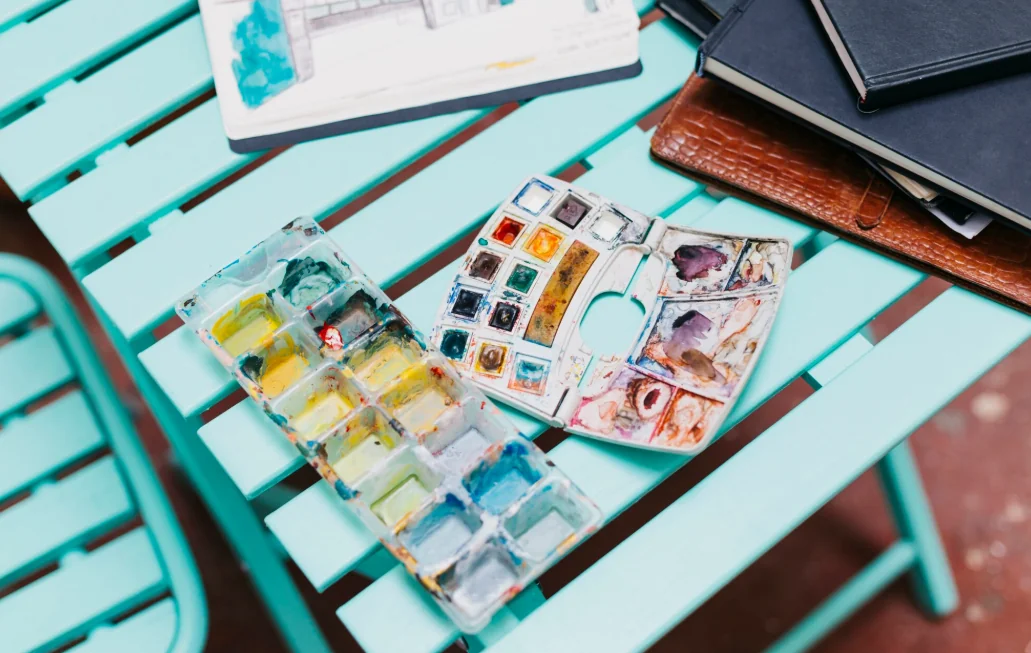
A watercolour set built to be used outdoors, badly, in bad weather, and to look worse the longer it works.
Terra Pigment Works makes pans and palettes for urban sketchers. The brief for this range came from watching them: painters standing at café tables, holding a palette in one hand and a sketchbook in the other, with nowhere to put anything down. The studio’s response was a palette with a thumb aperture cut through the body, so the whole thing can be held like a shield, and a second flat tray that clips beneath it for mixing.
The pans are half-size and removable, seated in a moulded tray with a slight undercut so they stay put when the palette is held vertically. Pigments are cast rather than pressed, in a formulation with more honey and less filler than the studio’s studio-use range, so the paint rewets in seconds with cold water from a bottle. Colours were chosen for southern European light: three earths, two blues, a warm and a cool yellow, and a single black.
Surfaces are matt white ABS with a fine texture that takes a wash without beading. The studio expected staining and designed for it, testing the finish specifically for how the colour rings would look after a hundred sessions. The photograph shows a set roughly two years old. Nothing about it has been cleaned for the shot.
The set ships in a canvas roll with the mixing tray, a folding brush and a small sponge, and it fits the outside pocket of a standard messenger bag, which was the dimensional constraint the studio worked back from.
The jury enjoyed the honesty of the proposition and the decision to design for the used state rather than the boxed one. It considered the thumb aperture a real improvement on standard field palettes. The entry sits in Honorable Mention because the object is an incremental refinement of a long-established type, and because the mixing tray clip proved fragile in the jury’s handling.
Terra Pigment Works is a five-person maker in Porto, producing artists' watercolours and palettes since 2018. The company mills its own pigments for part of the range and buys in the rest, and it sells mainly through art shops and its own workshops. Founders Inês Rocha and Tomás Vidal are both practising painters and test every product on location before release. The studio publishes its lightfastness testing and replaces individual pans by post, which has given it an unusually loyal customer base for its size. Rocha handles pigment work and Vidal the moulding and tooling. The company runs monthly sketching walks in Porto that double as product testing, and several of its palette revisions have come directly out of them.