A museum of ceramics in Aveiro, built on a corner site between a canal and a nineteenth-century street.
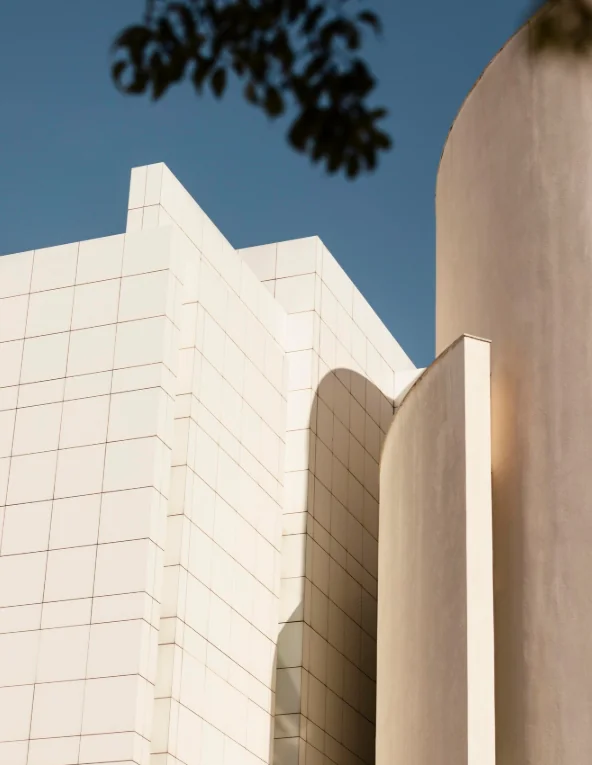
The building is two forms. An orthogonal volume, stepped in plan to follow the street line, holds the galleries. A tall cylinder holds the stair, the lift and, at the top, a single room for the museum’s most important object. The two meet along a curved seam, and the gap between them widens as it rises, so the drum appears to be pulling away from the block.
Both are clad in the same material: a white limestone-aggregate cast panel, 900 mm square, with a fine open joint. On the flat wall the panels read as a grid, sharp-edged and regular. On the drum they are set on a shallow curve with the joints running vertically, and the grid loses its horizontal lines, so the cylinder appears smoother and more solid than the block it sits against. Same panel, two readings.
The whiteness was contentious locally. Atelier Sá argued for it on the grounds that Aveiro’s light off the water is cool and blue for much of the year, and that a white wall is the only surface that records it accurately. In the afternoon, as the photograph shows, the west faces go warm and the north faces stay grey-blue, and the building displays the time of day at the scale of a city block.
Openings on the street facades are few and recessed deeply into the panel plane. The galleries are top-lit through a sawtooth arrangement hidden behind the parapet, which keeps daylight off the ceramics while giving the rooms a north light that does not need supplementing until dusk.
The drum is windowless except for a single horizontal slot at its top, aligned on the canal.
The jury admired the discipline of using one cladding panel to produce two entirely different surfaces, and the sawtooth section above the galleries. It placed the entry below the top award because the ground-floor entry sequence is cramped, and because the drum’s interior does not deliver on the promise its exterior makes.
Atelier Sá is a Porto practice of twelve, founded in 2010 by Rui Sá. The office works mainly on cultural and educational buildings in northern Portugal and has an established interest in cast stone, which it has used on eight completed projects. It runs its own panel mock-up yard behind the studio. Sá worked for six years in Switzerland before returning, and the office's detailing owes something to that period, a debt it acknowledges freely. The studio is deliberately small and takes two projects at a time, with Sá on site weekly for the duration. Its associate, Beatriz Lima, has led the cast-stone research since 2016.