A café attached to a district library in Brno, occupying a service hall that had been used for deliveries since the 1970s.
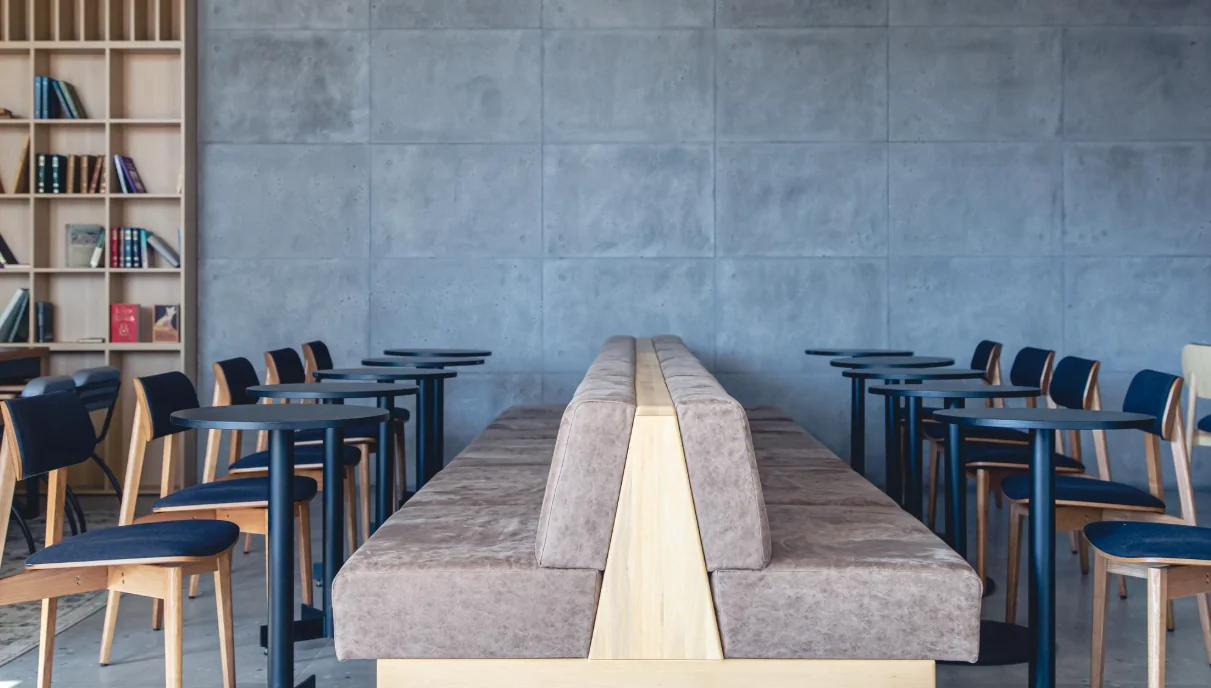
Atelier Beton kept the building’s own material and made it the subject. The back wall is board-formed concrete, cast in situ against sawn pine shuttering and left with its tie holes and panel joints on show. The grid those joints make is the only pattern in the room, and every other element was sized against it. Nothing on that wall is hung, painted or lit directly.
Facing it, a full-height shelving structure in pale birch ply runs the length of the side wall, holding the library’s overflow stock. Readers are allowed to take books to the tables and are trusted to put them back. The shelf module is deliberately irregular — some bays are tall enough for atlases, others hold paperbacks two deep — so the wall reads as contents rather than as cabinetry.
The centre of the room is a single double-sided banquette, nine metres long, built as a light timber spine with two upholstered benches in a soft grey-brown leather. It seats sixteen and is the only piece of furniture in the room that cannot be moved. Around it sit black steel pedestal tables and bentwood chairs with navy wool seats, chosen from a Czech maker still working with the interwar tooling that produced the originals.
The floor is the original slab, ground and sealed. Services run exposed above, painted out in the same grey. Lighting is a grid of small recessed downlights aimed at the tables and not at the concrete, so the wall stays in shadow and the reading surfaces stay bright. The room is legible at a glance and difficult to photograph badly.
What convinced the jury was the seating logic. A long shared bench in a public café is a risk: it can read as institutional and empty out. Here the spine’s height and the back-to-back arrangement give each side privacy without partitions, and observation over the first year showed the bench filling before the individual tables. The jury called the project a rare case of a low budget producing a better answer than a large one, and noted that almost nothing in the room was bought new.
Atelier Beton is a Brno practice of seven, founded in 2011 by Jakub Hořejší and Věra Nováková, both of whom worked in structural engineering before turning to interiors. The studio specialises in adaptive reuse of late-socialist public buildings, a stock that Czech cities hold in quantity and rarely know what to do with. It works with a fixed group of local fabricators and refuses imported furniture on principle. The office runs an annual open workshop teaching concrete repair to building managers. Hořejší leads the technical side and Nováková the interiors. The studio has completed eleven library, school and community-centre projects since 2015 and has a standing policy of publishing its material costs.