
A gift object made for music schools to present to students at their first recital, produced in short runs and personalised by hand.
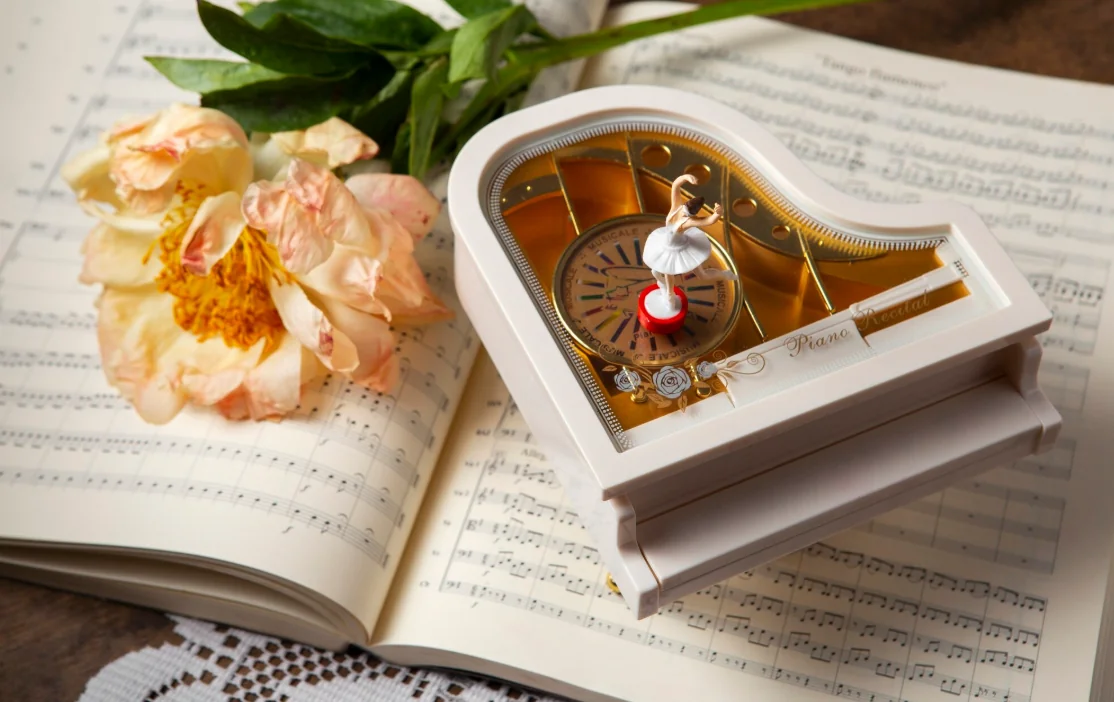
The form is a grand piano at roughly one-eighth scale, in cream ABS with a lacquered finish. The lid lifts on a working hinge to reveal a brass movement plate, a dancing figure on a red spindle, and a printed dial marked with the eighteen-note comb positions. Underneath, a wind key and a felt base. The whole thing sits in the hand and weighs about 340 grams, most of it in the movement.
Meilin Craft Studio’s contribution is less in the mechanism, which is a standard eighteen-note Sankyo unit, than in the decoration and the way it is applied. The fallboard carries the words Piano Recital in a gold script transfer, and beneath the lid a spray of white roses and gold foliage is applied by hand, one piece at a time, by four decorators working from a positional guide rather than a template. Each unit is signed on the underside.
The dial is the detail the studio is proudest of. Rather than a plain plate, it is printed as a segmented ring in the colours of the eighteen notes the comb can strike, so the movement’s range is visible when the lid is open. It carries no function. It exists to make the mechanism legible to a nine-year-old.
The keyboard is moulded, not separate keys, a cost decision the studio defends on the grounds that a working keyboard at this scale would be fragile and disappointing.
Tunes are configurable at order: schools choose from twenty-four public-domain pieces, and the movement is fitted at assembly.
The jury found the object charming and well made for its price, and singled out the coloured dial as a small piece of genuine design thinking in a category that usually has none. It placed the entry in Honorable Mention because the piano form is generic to the gift market and the studio’s work is confined to surface and finish, accomplished as that work is.
Meilin Craft Studio is a family workshop in Taichung, in its second generation, making music boxes, small lacquerware and gift items. It employs fourteen people, of whom six are hand decorators trained in-house over a two-year apprenticeship. The studio takes short-run commissions from schools, temples and corporate clients, with minimum orders low enough for a single class year. It has resisted moving assembly offshore, which keeps its unit price high and its lead times short. The workshop is run by Mei-Chen Wu, who took over from her father in 2011 and introduced the studio's first in-house design role. Decoration guides are drawn by hand and kept on file so that a repeat order years later matches the original.